VWO Pricing in 2026: Wingify's Tiers, and Why Five Numbers Circulate
 Written by Martin J.
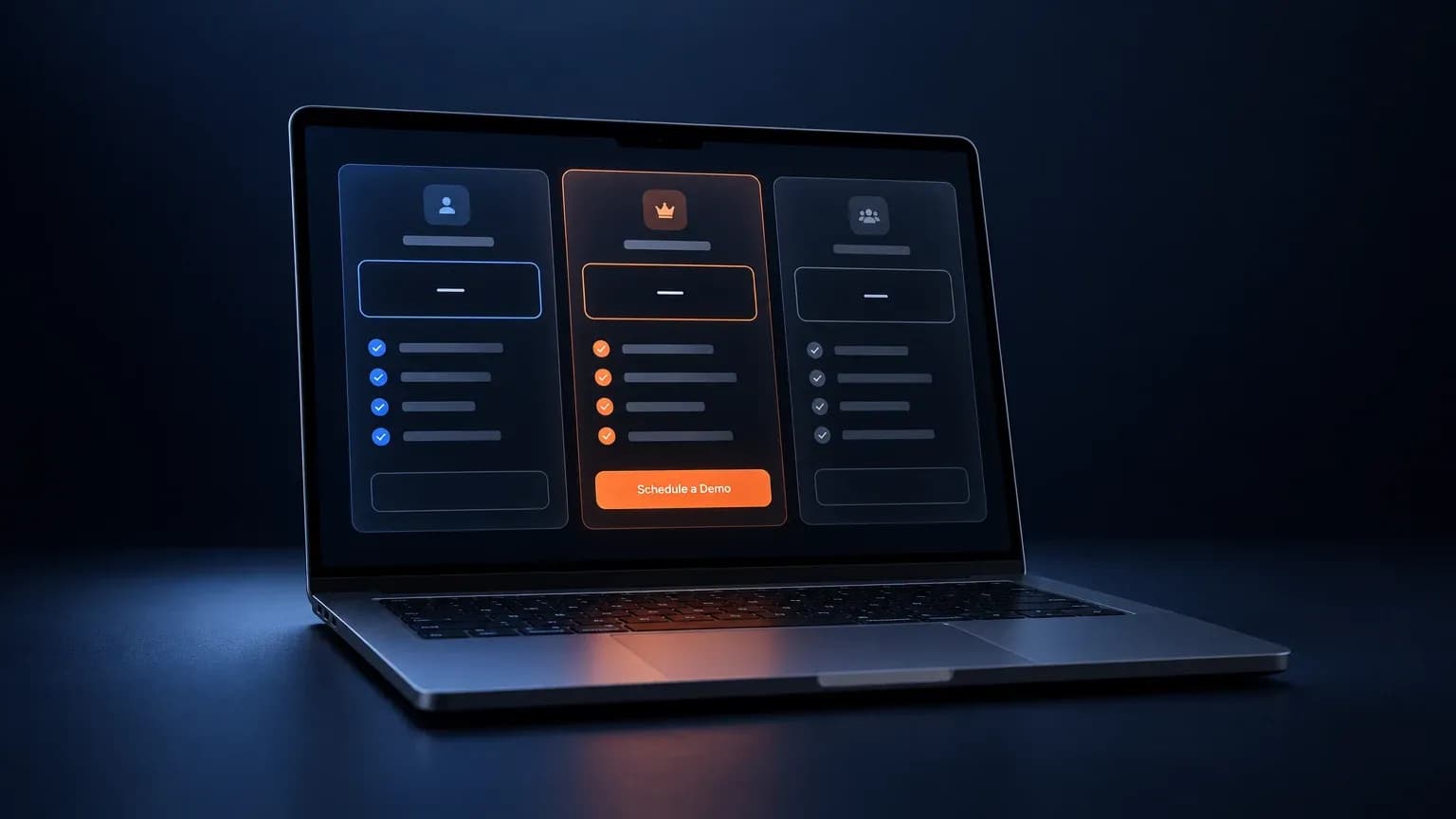
The pricing page lists three tiers and no numbers at all, and the guides that do quote figures disagree by thousands a year. One of those figures is probably in your budget. Which basis was it computed on?
Open three tabs on this platform and you get three monthly numbers. Not one of them is printed by the company that sells it, and not one of them says what basis it was computed on. The vendor's own pricing page, read on 13 November 2026, offers a demo button where a figure should be. So every number attached to VWO pricing in 2026 was reconstructed by somebody with a reason to reconstruct it, and the one in your budget is one of them.
The gap got filled by whoever had something to sell. A competitor's estimate reads like a measurement. A screenshot from inside a trial account reads like a rate card. A procurement average reads like a list price, and a post written in 2024 reads like a current quote. Each is a different kind of evidence, and only one kind survives being repeated back to a salesperson. Which kind is in your spreadsheet?
VWO Is Now Wingify, and Personalization Is One Product Inside It
On 20 January 2026, VWO and AB Tasty announced they were joining forces under Everstone Capital: more than $100M in revenue, 4,000+ customers, around 800 employees across 11 offices. The unified brand launched in September 2026, after the application moved from app.vwo.com to app.wingify.com in June. Read on 13 November 2026, wingify.com/pricing/ carries the Wingify wordmark, and vwo.com/pricing serves that same document. Two independent checks record the old address as a 301, which I did not observe myself.
The naming trips people up, including most of the pages ranking for this query. The company is Wingify. The platform that sold as VWO for years now sits under that name. Wingify Personalization is a product inside it, the successor to VWO Personalize, with its own Growth, Pro and Enterprise ladder. "VWO, now called Wingify Personalization" is a review-site listing.
What the merger did not do is reset the price list. The announcement says it plainly: "All existing client relationships, contracts, pricing, service levels, and support remain unchanged." If pricing was unchanged, nothing the field quotes is a post-merger reaction.
One sentence of housekeeping: this page is about experimentation and personalization software pricing, so if you wanted the Vanguard fund that uses the same three letters, leave now.
How VWO Pricing Is Structured
Wingify pricing is built on traffic, not on seats. The exact traffic metric is where the vendor's own documentation stops agreeing with itself.
Its pricing FAQ, read 13 November 2026, says: "Pricing is based on your Monthly Active Users (MAUs), depending on the product. However, for Behavioural Analytics, pricing is based on Monthly Tracked Users (MTUs) which can be a subset of your MAU." Its Help Center article on visitor counting, read the same day, says: "Wingify scales your monthly visitor quota consumption using MTU." Both are vendor surfaces, both are live, and they disagree.
Read together, that looks like an unfinished migration inside the company rather than a third-party error. The consequence: confirm the unit your contract bills on, in writing, before you sign. Third-party explainers here, and Google's AI Overview on this query, still treat MTU as the only axis.
What the Help Center does settle, read 13 November 2026, is the counting rule. Quotas do not roll over in any tier, a visitor counts once however many campaigns they enter, and once across every domain in a cross-domain campaign. Quotas are held per product, so experimentation and personalization draw on separate allowances.
Then the structural fact behind most of the confusion below. The pricing page carries six product families (Experimentation, Personalization, Feature Management, Analytics, Commerce, Customer Engagement), each with its own Growth, Pro and Enterprise ladder. There is no single VWO price: buy experimentation, then personalization, then analytics, and you have bought three ladders. Retention is published even where price is not: 13 months across the board, except Behavioural Analytics at 30 days on Growth, 60 on Pro and 90 on Enterprise.
What Wingify Publishes: Three Tiers and No Prices
Read on 13 November 2026 at 20:57 CET: HTTP 200, page title Pricing & Plans | Wingify Platform. No currency figure appears anywhere on it. I checked three ways, because a search that returns nothing is weak evidence on its own: rendered text, a visual read of the cards, and static HTML. The last returned zero dollar matches.
The vendor's own FAQ states the model: "Wingify offers custom pricing tailored to your needs, based on factors like traffic volume, selected products & plans, implementation scope etc." Every paid path on the page routes to Schedule a Demo, and the secondary button is Start Trial.
Tier | Vendor's positioning line | What the gate tells you |
|---|---|---|
Enterprise | For large teams, agencies and enterprises with advanced requirements | Everything in Pro plus self hosting, SSO, API access, approval workflow, mutually exclusive groups, rich widget library and 24x7 support. Procurement conversation, not a checkout. |
Pro | For businesses looking to scale experimentations | Everything in Growth plus multivariate testing, sample ratio mismatch detection, guardrail metrics, cross domain testing and user collaboration. The step most testing programs eventually take. |
Growth | For small teams getting started with experimentation | Visual and code editor, unlimited experiments and metrics, basic targeting and reporting, multi arm bandit and rollout campaigns, QA assistant, SPA support, Wingz AI core plan. The entry rung, with nothing beneath it. |
The gate is the only published signal of what costs more, and it is usable: if you need SSO, self hosting or API access, you are on Enterprise. Gartner's March 2026 B2B buying survey (n=646, fielded August and September 2025) found 67% of buyers prefer a rep-free buying experience, up from 61% a year earlier. A page whose only route to a number is a demo call is rep-gated, and two thirds of the people arriving at it would rather not be.
Why the Field Quotes $139, $422, $665, $1,336 and $18,086 a Year
Six sources, five bases, none of them a published list price. Sort them by basis and most of the disagreement disappears.

Figure | Source and date | What it actually is |
|---|---|---|
$139 to $179 Growth, ~$422 Pro, $775 to $997 Enterprise | Personizely, December 2025 per its search listing | The author's own estimate. Every figure is labeled Estimated price, and the same page carries a second table with different ranges for the same tiers. |
$665 Growth annual, $798 Growth monthly, $1,336 Pro annual ($16,032 a year) | Mida, May 2026 | An in-app checkout capture at 100K traffic. One account, one date, visible only after registering. |
$18,086 a year median, range $7,200 to $41,712 | UXtweak citing Vendr, January 2026 | A negotiated median across a procurement sample. Superseded by the row below. |
$16,330 a year median, range $7,820 to $35,790 | Vendr, last updated February 2026 | The live negotiated median, and the sample size contradicts itself on the same page. |
$16,660 a year median, range $7,880 to $36,390 | ConversionWax citing Vendr, undated | A third snapshot of the same dataset at a third sample size. |
~$314 a month for Starter at up to 10K | Vendr buyer guide, as quoted by ABTestly, September 2026 | An inference attached to a tier the vendor no longer sells. Not a published price. |
Here is what nobody in the top results says. Four of those six sources trace back to the same procurement dataset. Vendr's own page, last updated February 2026, gives a $16,330 median with 20.28% average savings. UXtweak attributed $18,086 to the same vendor in January 2026, ConversionWax quotes $16,660 across 95 contracts in an undated post. One dataset, read on four days, at four sample sizes. Vendr cannot even agree with itself: 66 deals handled in the header, "Based on data from 102 purchases" in the body. The apparent disagreement is one procurement sample photographed at different moments, one competitor's estimate table being copied, and a ladder from 2024 and 2025.
The estimate table travels furthest because it looks the most precise. Personizely labels each figure Estimated price in a table dated December 2025, then gives a second table with different ranges for the same tiers: $139 to $179 for Growth in one, $198 to $314 in the other.
The stale ladder is easier to spot once you know its shape. $199 for a Starter tier capped at 50,000 visitors (1Capture, dated January 2025), $308 a month (undated), $314 and $159 and $295 for Testing, Insights and Personalize (Eppo, dated 21 June 2024), $399 a month (a review directory, read 13 November 2026).
Which leaves the number that actually matters, and it is not a number. Reported annual contract values run from $7,200 to $41,712 on the January 2026 reading, narrowing to $7,820 to $35,790 on Vendr's own page read 13 November 2026. That is a 5.8 times spread on the same product, which tells you the price is a negotiation outcome rather than a rate. You are not choosing between the Growth quote and the Pro quote; you are choosing how well prepared you are for one conversation.
If you are pricing the category rather than this vendor, the conversion rate optimization tools guide covers the build decision, and conversion rate optimization services covers what it costs to have somebody else run the program.
The Free Tier Is Absent, and the Vendor Does Not Say Why
There is no Starter tier and no Free tier anywhere on the pricing page, read 13 November 2026. The only no-cost route is a 30-day trial. Wingify publishes no notice that a Starter tier is being, or has been, withdrawn: I searched the pricing page, its FAQ and the trial page and found none.
That combination is what to hold on to. The absence is verified. The reason is not.
The reason comes from third-party reporting. Mida, retrieved 8 October 2026, and PulseCRO, published 3 July 2026, both state that existing accounts were told the tier ends. Neither shows the notification. The 50,000 visitor cap on Starter is also third-party only. So "the entry rung disappeared from the site" is a claim you can repeat with an attribution attached. "The vendor announced it" is not.
What to plan for is clearer than the history. If you are new, the first paid tier is your floor. If you hold an old account, your contract is the only durable evidence of what you are entitled to.
What an Account at 25K, 100K and 500K Monthly Visitors Pays
The assumption first: with no published ladder, nobody can print what an account at a given traffic level pays. What exists is one captured quote.
Traffic level | Captured figure | Basis and date | Status |
|---|---|---|---|
25K monthly visitors | none found | none | no published or captured figure |
100K monthly visitors | $665 a month Growth annual, $798 monthly, $1,336 a month Pro annual ($16,032 a year) | In-app checkout capture, Mida, May 2026 | one data point, not a rate card |
500K monthly visitors | none found | none | no published or captured figure |
The 100K row is the only one with a number in it. Mida captured it inside the product in May 2026 after registering, and says so: the figures only appear in the app. A real quote at a real traffic level, on a stated date, unreadable without an account. Mida also competes with the product it quotes. The other two rows stay empty: interpolating a 25K figure from a 100K quote would produce a number with no source behind it, which is exactly the move that put four incompatible bases in this field.
Because the quota is metered and traffic is uneven across a month, a seasonal peak is what pushes an account over a tier boundary, which is why ecommerce conversion optimization programs hit it first.
Annual Versus Monthly
Nothing published says what annual billing saves. The vendor states that bundles and longer contracts carry a discount and attaches no percentage.
The only concrete pair in the field is Mida's 100K capture, May 2026: $665 a month on annual billing against $798 on monthly, same tier, same traffic level. Derived from those two figures, that is roughly 16.7%. Treat it as one observed pair, not vendor policy: it tells you the commitment is priced, not that 16.7% is what you will be offered.
Ask instead for the ratio on your own traffic level, in writing, plus the termination term for the billing period you pick. And if the commitment is what is stopping you, Google Ads experiments will split test your own traffic without a new contract.
Conclusion
Nothing on the page is a price, and that is the finding. VWO pricing in 2026 is three tiers, three positioning lines and a demo button, and the vendor's own FAQ calls the model custom. Everything with a dollar sign attached comes from somebody who is not the vendor: a competitor's estimate, an in-app capture, a procurement median, or a ladder that stopped being true before 2026.
So the useful preparation is arriving knowing your traffic level and which product families you need, which is how you tell whether you are looking at one ladder or three. Then ask for the annual ratio and the termination term in writing.
The number you were quoted is probably real. It is just not yours yet.
FAQ
How much does VWO cost per month?
There is no public answer, and that is not evasion. Wingify's pricing page, read 13 November 2026, carries three tiers and no currency figure, and every paid route ends at Schedule a Demo. The nearest thing to a number is a captured 100K traffic quote from May 2026: $665 a month for Growth on annual billing, $798 monthly, Pro at $1,336. Your figure depends on traffic, how many of the six product families you buy, and what you negotiate.
Is VWO now called Wingify?
The company is Wingify. VWO was the brand the platform sold under, and since the September 2026 launch of the merged brand the pages, the application domain and the invoices carry Wingify. Wingify Personalization is a separate product inside that platform, successor to VWO Personalize, with its own ladder.
Does VWO still have a free tier?
Not on the vendor's pages. No Starter and no Free tier appear on the pricing page as read on 13 November 2026, and the only no-cost route is a 30-day trial. Whether a tier was formally withdrawn is reported by third parties rather than stated by the vendor, so the absence is the fact and the announcement is the claim.
Why do different sites quote different VWO prices?
Because they are quoting different things. An estimate table, an in-app quote, a negotiated median and a ladder retired in 2024 or 2025 all appear as though each were the price. Four of the six sources trace to a single procurement dataset, where reported contract values run from $7,200 to $41,712 a year.

Price it against your own traffic, not somebody else's screenshot
Allable connects search, ads and content data in one workspace, so the traffic numbers behind a platform decision come from your accounts instead of a competitor's estimate table. Plans run Pro EUR 99, Business EUR 199 and Scale EUR 399 a month, each starting with a 7-day free trial.